Category Archives: Worship
The Great Dividing Range
 I had the good fortune to work with a great team of people during the weekend. This small band of musicians and singers were from Hope Church on Queensland’s Sunshine Coast. We covered a lot of ground during the full day workshop including an in-depth study of John 4 (Jesus and the Samaritan woman), the essential discipline of vocal warm-ups and a constructive workshop with the whole band as we took a fresh look at an old song on their repertoire list. It was during the practical workshop with the band that one of the singers asked, “What is the ideal range for a worship chorus?” Coincidentally, a good friend of mine messaged me on Facebook (not more than 48hrs after the workshop) to ask the very same question. My FB friend’s question reads,
Taking into account the different generations and genders, do you think there is an ‘ideal’ range for corporate singing (particularly corporate church singing)? The flipside question: is there a ‘no-go’ range (up or down) that you should avoid?
This is an age-old question, and a good one to be asking; it reveals a desire to develop an inclusive time of worship. There is a reason why the question is asked a lot, and why it is not easily answered: there’s no ideal range that will be the ‘one-size-fits-all’ solution. Why? Well, the different sexes of your congregation are one reason: male and female voices sing comfortably in different registers. What feels comfortable for men will not always be comfortable for the females in the church and vice versa. Secondly, the multiplicity of voice types within a single congregation creates an inherent challenge: what is comfortable for the lower female voice (alto) won’t necessarily work well for the higher female voices (sopranos). This all being said, there are a couple of guiding parameters which might prove helpful.
Highest and Lowest?
When I am asked the general question of ‘what’s the best vocal range?’ typically the interested person is seeking to be governed by a ‘highest and lowest’ note. Admittedly, I wish I could make things easy and give a definitive answer here. Over the years I have read many texts which have tackled this issue. Interestingly each text seems to offer different answers, so allow me to suggest that notes between G3 and G4 are singable by most people most of the time; with men singing an octave lower than the women. To the observant reader, this means that when we prescriptively apply the limits I have just suggested we are restricted to an octave: this in turn significantly restricts the choice of repertoire. There is a second rule that we can apply that offers a little more scope: tessitura.
Tessitura
William Vennard’s (1968) definition explains that the singer’s tessitura is “that part of the range in which the voice performs best, both as to sound and as to ease” (p. 67). McKinney (1994) furthers Vennard’s simplified definition by writing,
Two songs may have the same general range but different tessituras, as shown in this example [Figure 1]. There are some singers who can sing both of these tunes comfortably; there are others who can handle the range without any problem, but who find the tessitura of the second tune very demanding because it lies so high within the octave. (p. 111)
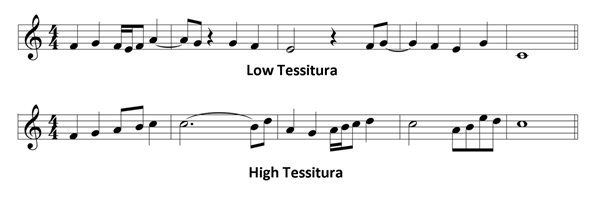
Figure 1: Low and High Tessitura
Our focus here is not vocal health, but it is worth noting that it seems the sustaining of a melodic line whose tessitura remains high for an extended period might predispose the singer to vocal wear and tear. Judith Wingate (2008) certainly thinks so. She writes, “If the singer experiences chronic vocal fatigue from singing in an extreme tessitura for long periods of time, vocal injury may result” (pp. 58–59). Daniel Zangger Borch (2005) complements Wingate’s concerns when he writes “Obviously if someone is forced time and time again to sing numerous choruses at the top of their range their voice will give out” (p. 93). Herein lays the challenge: people stop singing when they start to feel physical discomfort. Assessing the tessitura of a song requires that the worship/music director identify where the mean average of the melodic line sits. Again, one must avoid the temptation to be too rigid here. For example, once a congregation has sung a couple of songs they may feel more able to sustain a slightly higher tessitura and so different songs work better (or otherwise) at different points in a worship service. Effectively, the aim is to maintain the tessitura within the boundaries of G3 and G4 allowing for the occasional note to stray outside these parameters. Remember, the key is to have most of your congregation singing most of the time.
Finally, despite the guiding limitations that I have mentioned above I would encourage every worship/music director to take up the challenge of developing their congregation’s overall vocal capacity. Cherry, Brown and Bounds (2011) encourage the very same when they write, “each leader must discern what their congregation’s current singing capabilities are while leading them to grow in their singing skills to the glory of God” (p. 48). The wise music director will take a long-term approach to the congregation’s vocal range development; it will take years…not weeks or months J
I am conscious that I have not covered this subject comprehensively here, so I eagerly invite you (my readers) to add to this post in the comments section. We will all benefit from the additional hints and tricks that you have learned from your experiences.
References
Borch, D. Z. (2005). Ultimate vocal voyage: The definitive method for unleashing the rock, pop or soul singer within you. Bromma, Sweden: Notfabriken Music Publishing AB.
Cherry, C. M., Brown, M. M., & Bounds, C. T. (2011). Selecting worship songs: A guide for leaders. Marion, IN: Triangle Publishing.
McKinney, J. C. (1994). The diagnosis & correction of vocal faults: a manual for teachers of singing and for choir directors (2nd ed.). Nashville, USA: Genevox Music Group.
Vennard, W. (1968). Singing: The mechanism and the technic (5th ed.). New York, NY: Carl Fischer.
Wingate, J. (2008). Healthy singing. San Diego CA: Plural Publishing.
On Bended Knee
While discussing heavenly and new creation worship, as describe in Revelation, a friend bought the following quote to my attention:
“Here’s what I think is really sad. When I looked up internet search engines for pictures of Christian worship, 99% of the pictures were of people with their hands raised above them. But when I looked up general pictures of worship from other religions there was a surplus of people bowing down on a mat with their heads on the ground while giving homage to a fake god.” Jacqueline Hadley (2010).
My thoughts were as follows…
 While preparing to reflect on the statement by Hadley (as outlined above), I decided to conduct a similar search. Using Google as as the search engine and with the two delimiters of “Christian” and “Worship” my search also produced many images of uplifted hands, but it also depicted people in a posture of prayer as well as the display of the Eucharist (among many other illustrative representations). A similar search for “World Religions Worship” did not produce a ‘surplus of people bowing down’ until I narrowed the search string to “Muslim Worship”; only then did my PC screen fill with photos of worshippers “with their heads on the ground.”
Regardless, I guess what Hadley is striking at, albeit in a manner that is designed to be inflammatory and invoke debate, is that the archetypal picture of the Western Christian has become the backlit torso with arms upheld in a gesture of praise and adoration to an unseen God (who is presumably out of shot  ). Why aren’t Christians regularly depicted in the submissive stance of bowing low to the ground? I wonder whether the rugged individualism that has been weaved into the fabric of our being as a result of the modernist revolt against the communal subservience of the medieval era has left us with an inherent unwillingness to ‘bow the knee’ to the incumbent monarch.
Furthermore, as Webber (2004) highlights “The Enlightenment [modernism] taught that only that which could be proven could be believed. We evangelicals have been greatly influenced by the modern demand for proof” (p. 150). Has this requirement of proof left our western sensibilities requiring hard evidence before we bend our erect self-righteousness to anything or anyone who is unseen, not to mention unneeded and unwanted. God have mercy! We have lost our awareness for God’s true weightiness in being.
What strikes me about the passages in Revelation is the central knowingness of God’s vast person. In Revelation God is simply accepted as “I am” because He is! In writing about God’s ontic weight John Jefferson Davis (2010) highlights that “this notion of the weightiness of God as the truly, densely, intensely and profoundly ‘real’ is an expression of what has been traditionally in Christian theology called the aseity of God” (p. 50). The aseity of God, literally taken to mean “being from himself” (Cross et al, 2005, p. 115), is fully expressed and revealed throughout John’s Revelation. Praise God that we have a written record of John’s ‘reality dream’ because it reminds us of our temporal being and how all of creation is ultimately, like it or not, subservient to the one who was before all that is. I forget this to my own peril. I pray that I am found with bent knees of submission, upraised hands of adoration and a contrite spirit of repentance.
References:
Cross, F. L., & Livingstone, E. A. (2005). The Oxford dictionary of the Christian Church (3rd ed. rev.). Oxford; New York: Oxford University Press.
Davis, J. J. (2010). Worship and the reality of God: An evangelical theology of real presence. Downers Grove, IL: IVP Academic.
Webber, R. E. (2004). Ancient-future time: Forming spirituality through the christian year. Grand Rapids, MI: Baker Books.
What is Biblical Worship?
Zac Hicks // Worship. Church. Theology. Culture. – Zac Hicks Blog – What is Biblical Worship?.
I highly recommend reading the above post (link)

Image via Wikipedia
and the associated article – a must read for all involved in Christian worship. I also commend the comments after the article – a worthy discussion.
Well done Zach…another fantastic post!
 Voice in Worship